Hiring a Virtual Assistant is often seen as a solution to overwhelm, disorganization, and lack of time in business.
But here’s the reality many business owners quietly experience:
Some businesses hire Virtual Assistants…yet still remain disorganized, inconsistent, overwhelmed, or unable to grow effectively.
Why?
Because simply hiring a Virtual Assistant is not enough.
The real value of a Virtual Assistant is not just in “helping out” —it is in creating structure, efficiency, systems, consistency, and operational support that allows a business to function better.
And many businesses are still not maximizing that value.
A Virtual Assistant is not just someone who replies to messages or schedules meetings.
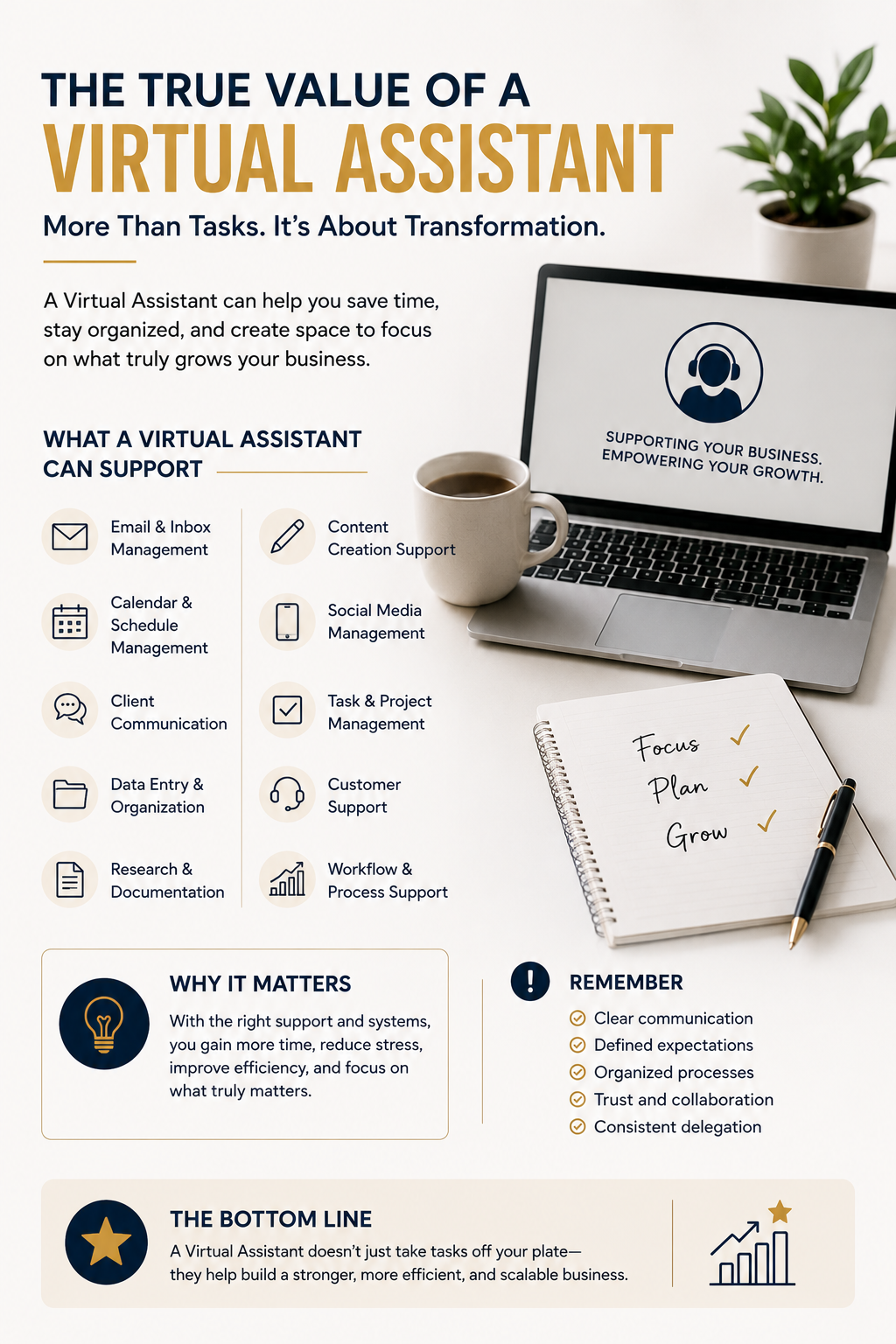
A skilled Virtual Assistant can help support:
🌿 Administrative organization
🌿 Client communication
🌿Calendar and task management
🌿 Content scheduling
🌿 Customer support
🌿 Research and documentation
🌿 Email management
🌿 Workflow coordination
🌿 Follow-ups and systems
🌿 Social media support
🌿 Lead organization
🌿 Project assistance
🌿 Operational efficiency
The problem is that many businesses hire Virtual Assistants without proper systems, communication, expectations, or understanding of how delegation actually works.
As a result:
× Tasks remain unclear
× Processes become inconsistent
× Business owners continue micromanaging
× Important work gets delayed
× Burnout continues
× Productivity barely improves
In some cases, businesses are not struggling because they lack help —they are struggling because they lack structure.
A Virtual Assistant works best in an environment where:
• Communication is clear
• Expectations are defined
• Processes are organized
• Tools are properly used
• Responsibilities are delegated intentionally
• Systems are documented
Another major misunderstanding is that many people view Virtual Assistants as “extra help” instead of strategic support.
The best Virtual Assistants do more than complete tasks. They help reduce mental overload.
They help business owners regain time, improve consistency, create smoother operations, and focus more on growth, decision-making, and higher-level responsibilities.
In today’s digital economy, businesses move quickly. Clients expect responsiveness. Content requires consistency. Communication needs organization. Operations need structure.
Trying to manage everything alone often leads to exhaustion, inconsistency, and slowed growth.
This is why Virtual Assistants are becoming increasingly valuable across industries.
However, businesses also need to understand that effective delegation is a skill.
Many business owners delay tasks because:
• They fear losing control
• They believe doing everything themselves is faster
• They struggle to trust others
• They lack documented systems
• They are unsure what should actually be delegated
But over time, trying to carry every responsibility alone can limit growth significantly.
One of the biggest hidden costs in business is operational overload.
When business owners spend too much time on repetitive administrative work, they often lose time for:
• Strategy
• Creativity
• Client relationships
• Learning
• Scaling
• Business development
A good Virtual Assistant does not replace leadership. They support it. And while Virtual Assistants are powerful, businesses must also recognize that productivity is not built on delegation alone —it is built on systems, communication, organization, and intentional management.
The businesses that benefit most from Virtual Assistants are usually the ones willing to:
• Build processes
• Communicate effectively
• Delegate intentionally
• Respect collaboration
• Focus on long-term efficiency instead of short-term control
Because in many cases, the issue is not that businesses lack support.
The issue is that they have not fully learned how to use support effectively.
In today’s fast-moving digital world, learning how to work smarter; not just harder can make a major difference in business growth and sustainability.
In your opinion, what is the biggest reason many businesses struggle with delegation and support systems today?